Delhi NCR is one of the busiest construction markets in India. New housing towers are launching in Noida, Greater Noida, Gurugram and Ghaziabad, data centres and logistics parks are coming up along the expressway corridors, and the opening of Noida International Airport at Jewar has pushed fresh commercial and residential activity into the Yamuna Expressway belt. Every one of these buildings needs electrical conduit, and most of it is bought close to where it is made.
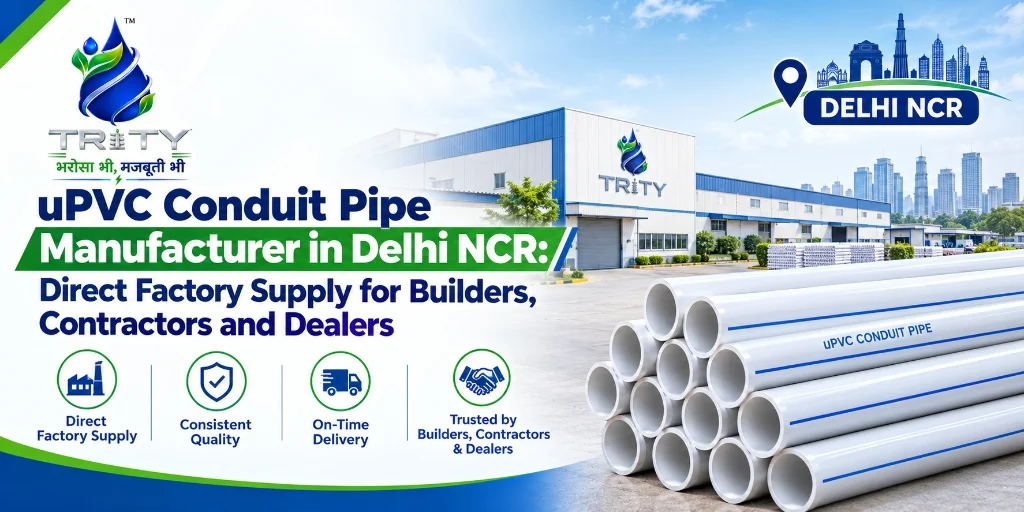
Trity Pipes manufactures uPVC conduit pipes and fittings at its factory in Ghaziabad, inside the NCR. This guide is for builders, contractors, MEP consultants and electrical dealers who buy in the region. It explains what NCR projects typically need, which conduit grade suits which kind of building, why buying directly from a manufacturer in the region helps, and how to get a quotation or start a dealership.
Why Delhi NCR needs reliable conduit supply
Several trends make conduit demand in NCR steady and large.
- Housing launches. Market reports for early 2026 point to a strong run of residential launches across NCR, led by Gurugram and Noida, with Ghaziabad also contributing a meaningful share.
- Airport and expressway growth. Noida International Airport, the Yamuna Expressway belt, the Noida-Greater Noida Expressway and the Dwarka Expressway are creating new housing, commercial and warehousing clusters.
- Data centres and logistics. Noida has a growing data centre corridor, and the airport's cargo facilities are expected to support logistics and warehousing around Jewar.
- Offices and institutions. Commercial towers, hospitals, schools and colleges continue to be built across the region.
For a contractor, this means tight schedules and large repeat requirements. For a dealer, it means a market where electricians and builders buy conduit every week.
Where Trity Pipes is located
Our factory and head office is at Phase 3, I-45, MG Road, Industrial Area, Shekhpur Khichara, Amapur Lodha, Ghaziabad, Uttar Pradesh 201015. That puts us close to Delhi, Noida, Greater Noida, Gurugram and Faridabad, and on the road network that feeds the rest of North India. Buying from a manufacturer inside the region helps in practical ways.
- Lower freight and shorter transit. Pipe is bulky, so distance directly affects landed cost.
- Faster top-up orders. When a site runs short on one size, a regional factory can respond faster than a distant plant.
- Direct conversation with the manufacturer. Specification questions, quotations and complaints reach the people who make the product.
- Factory visits. NCR buyers can visit the plant to see the extrusion line, raw material storage and finished stock before placing a large order.
Delivery time depends on quantity, location and current stock, and our team confirms it when we issue a quotation.
What NCR projects typically need
High-rise residential towers
NCR's tall residential projects need conduit for concealed wiring in every flat, plus riser shaft conduit for vertical distribution. MMS grade usually suits concealed flat wiring, and HMS grade is common in the heavily loaded sections of the riser. Our guide on conduit pipe for multi-storey buildings and riser shafts covers grade selection, fire stopping and expansion allowance in detail.
Commercial offices and malls
Offices and retail spaces need conduit in false ceilings, partitions and service shafts, often with frequent changes during tenant fit-outs. Our guide on conduit pipe for commercial buildings explains how specification differs from residential work.
Data centres and IT parks
These projects separate power from data, need high-capacity risers and demand strict documentation. Plan for spare conduit capacity and flame retardant material.
Warehouses and logistics parks
Large floors, forklift traffic and high-bay lighting call for HMS grade on exposed runs. See our guide on conduit pipe for warehouses and logistics parks.
Hospitals and institutions
Healthcare and education projects need certified, flame retardant conduit and careful circuit segregation. Our guides on conduit pipe for hospitals and conduit pipe for school buildings cover these in depth.
EV charging and parking
New residential and commercial projects in NCR increasingly plan EV charging. Our guide on conduit pipe for EV charging stations explains sizing and outdoor requirements.
Which grade for which NCR project
| Project type | Typical use | Suggested grade |
|---|---|---|
| Residential flats | Concealed wall and slab wiring | MMS |
| Riser shafts and basements | Heavy cable bundles, impact risk | HMS |
| Commercial offices | False ceiling, partitions | MMS |
| Warehouses and parking | Exposed runs, traffic | HMS |
| Hospitals and schools | Concealed, certified material | MMS, HMS in exposed areas |
| Outdoor and landscape lighting | Exposed or underground | HMS, UV stabilised where exposed |
Use this as a starting point and confirm against your project specification. Our LMS, MMS and HMS guide explains the grades, and our conduit pipe size chart helps match size to cable fill.
Seasonal conditions in NCR that affect conduit
NCR has hot summers, a humid monsoon and cold winters. Each affects installation.
- Summer heat makes uPVC expand, so long runs need expansion couplers and proper saddle spacing.
- Monsoon moisture calls for sealed boxes and proper joint curing before rain exposure.
- Winter cold makes pipe stiffer, so avoid forcing bends and warm the pipe before working it. Our guide on bending uPVC conduit without cracking explains the technique.
- Exposed rooftops and parking need UV stabilised conduit. See our guide on UV resistant conduit for outdoor wiring.
How to verify an NCR conduit supplier
The NCR market has many traders, and not every pipe carrying an ISI mark is genuine. Before ordering, ask for the BIS licence number and check it, ask for ISO documentation, and inspect a sample. Our guide on how to identify fake or substandard conduit pipe lists checks any buyer can run with a caliper and a weighing scale. You can see our credentials on the certifications page, and you are welcome to visit the factory.
Why NCR builders and contractors choose Trity Pipes
- IS 9537 Part 3 conduit made with ISO certification
- Lead-free, high-grade virgin raw materials and precision extrusion with in-process quality control
- LMS, MMS and HMS grades with matching fittings from one source
- Project and bulk quotations with clear rate validity and phased delivery. Our guide on buying conduit pipe in bulk explains how to structure an enquiry
- A manufacturer in your own region, with a network of more than 250 distributors and 1,500 dealers across 20-plus states
- A complete product range, including CPVC, SWR, pressure, column and casing pipes for projects that need more than conduit
You can browse the uPVC conduit pipes and fittings range and request the Trity Pipes price list for your requirement.
Dealership and distribution in NCR
NCR is a dense market, so dealer success depends on locality, service and range. If you run a hardware, electrical or building material business in Noida, Greater Noida, Ghaziabad, Gurugram, Faridabad or nearby towns, you can apply to represent Trity Pipes. Our guide on how to become a Trity Pipes dealer explains eligibility, documents and the application steps, and our article on choosing between dealer and distributor models helps you decide which fits.
How to get a quotation
- Call or WhatsApp us on +91-9821030072 or +91-9319984755, or email info@tritypipes.com.
- Share your requirement: project type, sizes, grades, quantity and delivery location.
- Receive a quotation with rate, validity, delivery basis and payment terms.
- Ask for documents such as certifications and datasheets for your approval process.
- Confirm delivery in phases that match your site programme.
You can also use the form on our contact page.
A closer look at NCR sub-markets
NCR is not one market. Each part of it has its own mix of projects and buyers.
Noida and Greater Noida
Housing towers, commercial buildings, data centres and warehouses are concentrated here, and the airport belt is adding more. Buyers are mostly large builders and EPC contractors, who need project quotations, documentation and phased delivery.
Gurugram and Manesar
Premium residential projects, office towers and industrial units dominate. Specification is often detailed, with consultants asking for compliance statements and approvals before any material is ordered.
Ghaziabad and Indirapuram
This is our home market. Mid-size housing societies, commercial complexes and a large base of electrical dealers and contractors buy here every day. Our own factory sits in this belt, so dealers and contractors can pick up stock or visit the plant.
Faridabad, Delhi and surrounding towns
Industrial areas, redevelopment, institutions and a very large number of small and mid-size wiring jobs. Dealers and wholesalers serve most of this demand.
What to share when you request a quotation
A complete enquiry gets a faster and more accurate quotation. Please share:
- Project type and location, including the town or sector
- Conduit sizes and grades needed, along with approximate quantities
- Fittings required, such as bends, couplers, junction boxes and saddles
- Whether any runs are exposed to sun or buried underground
- Your delivery schedule, and whether you need phased dispatch
- Any certification or document requirements from your consultant
Our team can then confirm the right grade for each area, prepare the quotation and discuss delivery.
What you can see on a factory visit
Many NCR buyers like to see a manufacturer before placing a large order. During a visit to our Ghaziabad plant you can look at how raw material is stored, how pipe is extruded and cut, how quality checks are carried out and how finished stock is labelled by size and grade. You can also meet the team who will handle your order. Bring your specification and your questions, because it is the quickest way to judge whether a supplier matches what your project needs. Photos of our facility are also available on our gallery page.
Frequently Asked Questions
Where is Trity Pipes located in Delhi NCR?
Our factory and head office is at Phase 3, I-45, MG Road, Industrial Area, Shekhpur Khichara, Amapur Lodha, Ghaziabad, Uttar Pradesh 201015, which is inside the NCR and close to Delhi, Noida, Greater Noida, Gurugram and Faridabad.
Does Trity Pipes supply conduit pipe to Noida, Gurugram and Faridabad?
Yes. We supply builders, contractors and dealers across Delhi NCR from our Ghaziabad factory. Delivery time depends on quantity, location and stock, and our team confirms it with your quotation.
Is Trity Pipes conduit ISI and ISO certified?
Our conduit is made to IS 9537 Part 3 with ISO certification, and the details are available on our certifications page. We recommend verifying the BIS licence number of any supplier before ordering.
Can I visit the Trity Pipes factory before placing a large order?
Yes, you are welcome to arrange a visit to see production, raw material storage and finished stock. Contact our team to schedule it.
Which conduit grade should I use for a residential tower in NCR?
MMS grade usually suits concealed wiring in flats, and HMS grade suits heavily loaded riser sections and areas with impact risk. Confirm against your project specification and consultant's requirements.
How can I become a Trity Pipes dealer in Delhi NCR?
Fill in the Become a Distributor form on our website or contact our team. We will discuss your location, current business and the range you want to stock.
Need conduit pipe for a project in Delhi NCR? Contact Trity Pipes on +91-9821030072 for a quotation, the Trity Pipes price list and factory-direct supply of ISO-certified uPVC conduit pipe from Ghaziabad.