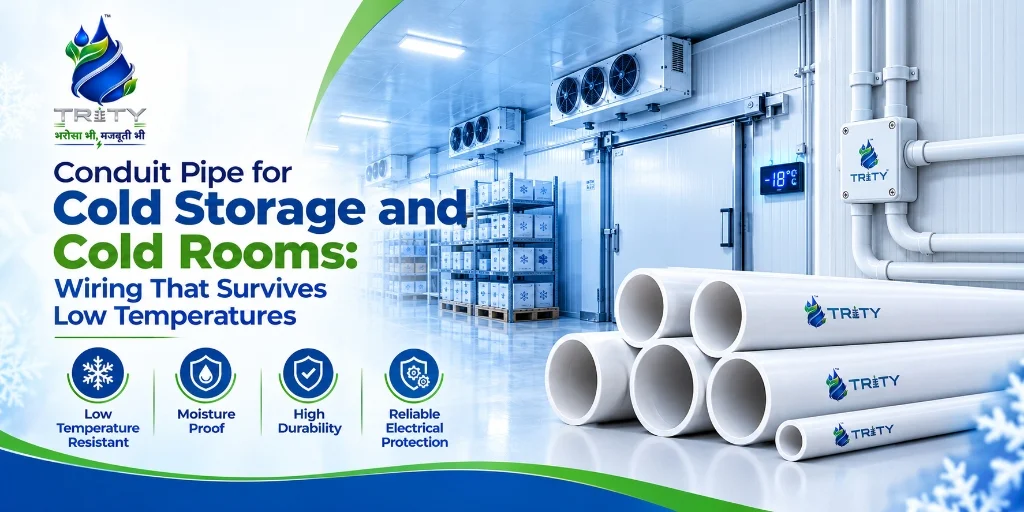
India's cold chain is expanding quickly, with new cold storages for fruit, vegetables, dairy, pharma and frozen food coming up in many states. Every one of these buildings needs a reliable electrical system, and conduit pipe is part of it. But cold storage is not an ordinary building. Temperatures swing between a hot loading dock and a freezing room, moisture condenses on cold surfaces, forklifts move constantly, and the compressors and evaporators run around the clock.
This guide explains how uPVC conduit behaves in these conditions, which parts of a cold storage facility suit it, which need extra care, and how to handle, seal and install conduit so that it performs for years. It is written for developers, EPC contractors, refrigeration contractors and facility managers.
Why cold storage is different from other buildings
Four conditions set cold storage apart.
- Low temperatures. Chiller rooms typically operate just above freezing, while frozen storage runs far below it. Materials get stiffer and more brittle as the temperature falls.
- Condensation and frost. Warm, moist air meeting a cold surface leaves water behind, and in freezer rooms it turns to ice. Any gap where conduit passes through an insulated wall can let moisture in.
- Heavy mechanical traffic. Pallets, forklifts and trolleys move in tight aisles, so low-level wiring faces more impact risk.
- Continuous operation. Refrigeration equipment, fans and lighting run for long hours, which puts constant load on circuits.
A conduit specification that ignores these factors may work for a few months and then start cracking or letting moisture into boxes.
How uPVC conduit behaves at low temperature
uPVC is a rigid thermoplastic, and like all PVC, it becomes stiffer and more brittle as the temperature drops. This does not mean it cannot be used in cold environments, but it changes how and where you use it.
- Brittleness matters mainly when the pipe is hit. A conduit protected from impact is not likely to be damaged by cold alone, but a sharp blow at low temperature can crack it.
- Handling and installation are the highest-risk moments. Cutting, bending and fixing conduit is far safer at normal ambient temperature than in a chilled space. Pipe that has been stored in the cold should be allowed to warm up before it is cut or bent.
- Cable insulation stiffens too. Standard thermoplastic cable insulation becomes stiff and can crack when handled in very cold conditions, so cable pulling should also be done at a suitable temperature.
- Compound quality matters. Pipe made from good virgin material with proper impact performance behaves better in cold than pipe made from recycled or filled material. Our guide on why uPVC conduit pipes break explains how raw material and wall thickness affect strength.
Where uPVC conduit suits a cold storage facility
Different zones of a cold storage have different operating temperatures, and the suitability of conduit changes with them.
| Zone | Typical condition | uPVC conduit |
|---|---|---|
| Plant room, office, panel room | Normal ambient | Well suited |
| Loading dock and corridors | Ambient with temperature swings | Well suited, use HMS where exposed to traffic |
| Anterooms and vestibules | Moderately cool | Suited with care |
| Chiller rooms (just above freezing) | Cold, high humidity | Generally suited with sealed fittings |
| Frozen storage rooms | Well below freezing | Confirm specification with the manufacturer; protect from impact |
For frozen rooms operating well below freezing, the safe approach is to confirm the exact conduit specification with the manufacturer, keep conduit out of impact zones, and in areas where a hit is likely, consider whether additional physical protection is needed. If you are designing such a room, speak to our technical team before you finalise the conduit grade.
Choosing the right grade
- HMS (Heavy Mechanical Stress) is the sensible choice for any run near forklift paths, dock doors, racking and anywhere conduit may be struck. Higher wall thickness gives more impact resistance.
- MMS (Medium Mechanical Stress) suits protected runs in plant rooms, offices and above false ceilings.
- LMS is generally not appropriate for cold storage because of the impact risk.
Our LMS, MMS and HMS guide explains the grades in detail, and our article on conduit pipe for warehouses and logistics parks covers the racking and forklift considerations that also apply here.
Sealing penetrations and managing condensation
Moisture is the long-term enemy of a cold storage electrical system. A few practices protect against it.
- Seal every conduit entry through insulated panels. An unsealed conduit can carry warm, moist air into the cold space, leading to condensation, frost and damaged insulation.
- Use moisture-proof boxes and glands, rated for dust and water ingress, in cold and damp zones.
- Enter boxes from the side or bottom so that water does not run down the conduit into the box.
- Keep boxes on the warm side where possible, and limit the number of joints inside the cold space.
- Coordinate with the panel supplier. Insulated panel systems have their own requirements for cable and conduit penetrations, so agree the details before installation.
- Use fire-stop and sealing materials that are suitable for the temperature and the panel type.
Thermal movement between zones
A run that passes from a warm dock into a cold room experiences very different temperatures along its length. Defrost cycles add further swings. Rigid, tightly fixed runs can stress joints as the pipe expands and contracts.
- Use expansion couplers at suitable intervals on long runs
- Avoid fixing every bracket rigidly along the whole length
- Place joints away from the transition point where possible
- Support conduit properly so that it does not sag where it passes through walls
Fire safety in cold storage
Insulated panel buildings and large stored loads make fire safety an important concern, and electrical faults are a common cause. Flame retardant conduit helps slow the spread of fire along wiring, and proper fire stopping at penetrations protects compartments. Our guide on fire resistant conduit pipe explains what flame retardant performance means and how to check it.
Installation tips for cold environments
- Install conduit before the room is brought down to operating temperature wherever the construction sequence allows.
- Warm the pipe before cutting or bending if it has been stored in a cold place.
- Use proper cutters and avoid forcing the pipe. Our guide on how to bend uPVC conduit without cracking covers technique.
- Pull cable before the space is chilled or at a temperature suitable for the cable type.
- Protect installed conduit from impact during later construction and during commissioning.
- Keep records of the conduit grade, batch and location for maintenance.
Why cold chain projects choose Trity Pipes
Trity Pipes is a manufacturer of uPVC conduit pipes and fittings made from lead-free, high-grade virgin raw materials, certified to IS 9537 Part 3 with ISO certification. For cold storage and cold chain projects, we offer:
- HMS, MMS and LMS grades, so you can match strength to each zone
- Consistent wall thickness and compound quality from controlled extrusion and in-process quality checks
- Matching fittings, boxes and saddles from one manufacturer
- Technical guidance on grade selection and handling for low-temperature areas
- Project quotations with phased delivery for large facilities
- A plant in Delhi NCR with a network of more than 250 distributors and 1,500 dealers across 20-plus states
Browse the uPVC conduit pipes and fittings range and ask our team for the Trity Pipes price list or a quotation for your cold storage project.
A specification checklist for your consultant
When you brief your electrical consultant or refrigeration contractor, ask them to define the following for conduit.
- The operating temperature of each room and zone
- Which areas are exposed to forklift or pallet traffic
- The conduit grade for each zone, with HMS marked clearly for impact areas
- The sealing method for every penetration through insulated panels
- The type and ingress protection of boxes and glands in cold and damp areas
- Expansion provisions on long runs and at zone transitions
- Fire stopping and flame retardant requirements
- The installation sequence, so conduit and cable are installed before the room is chilled
- Documentation and certification needed for approval
A written checklist like this avoids site-level guesswork and keeps the electrical, refrigeration and civil teams aligned.
Inspection and maintenance in a cold chain facility
Conduit in a cold storage needs less maintenance than most components, but a simple routine protects it.
- Inspect conduit near traffic areas after any impact incident and replace damaged lengths
- Check seals at panel penetrations for signs of ice, moisture or gaps
- Look inside boxes during routine electrical maintenance for condensation or corrosion on terminals
- Re-seal any penetration that has been disturbed by later work
- Keep records of the conduit grade and batch for each area, so replacements match the original
How to order conduit from Trity Pipes for a cold chain project
Cold chain developers and EPC contractors can approach us at the design stage or at procurement. Share your room temperatures, layout, quantities and schedule. Our team will discuss the right grade for each zone, prepare a quotation with the rate validity stated, and plan phased delivery to match the construction programme. We can also discuss certification documents for your consultant's approval. For the documentation consultants usually request, read our guide on material approval submittals for conduit pipe.
Frequently Asked Questions
Can uPVC conduit pipe be used in a cold storage?
Yes, in most parts of a cold storage facility, including plant rooms, offices, docks, corridors and chiller areas, with sensible handling and sealing. For frozen rooms operating far below freezing, confirm the specification with the manufacturer and protect the conduit from impact.
What grade of conduit is best for a cold room?
HMS grade is the safest choice wherever there is any risk of impact, such as near forklift paths, dock doors and racking. MMS suits protected runs. LMS is not usually appropriate for cold storage.
Does cold weather make PVC conduit crack?
PVC becomes more brittle as temperature falls, and the risk is highest during cutting, bending and installation, or when the pipe is struck. Installing at normal temperature, allowing stored pipe to warm up and protecting it from impact greatly reduces the risk.
How do I stop condensation entering conduit in a cold room?
Seal every conduit entry through insulated panels, use moisture-proof boxes and glands, enter boxes from the side or bottom, and keep joints and boxes on the warm side where you can.
Should conduit be installed before or after the cold room is commissioned?
Wherever possible, install conduit and pull cable before the room is brought down to operating temperature. This avoids the handling risks of working with brittle material in a chilled space.
Can Trity Pipes advise on conduit for freezer rooms?
Yes. Share your room temperature, layout and traffic details, and our technical team will discuss the right grade, handling and protection for your project before you order.
Building a cold storage or cold chain facility? Contact Trity Pipes to discuss conduit for rooms below freezing, request a project quotation and get certification documents from an ISO-certified uPVC conduit pipe manufacturer.