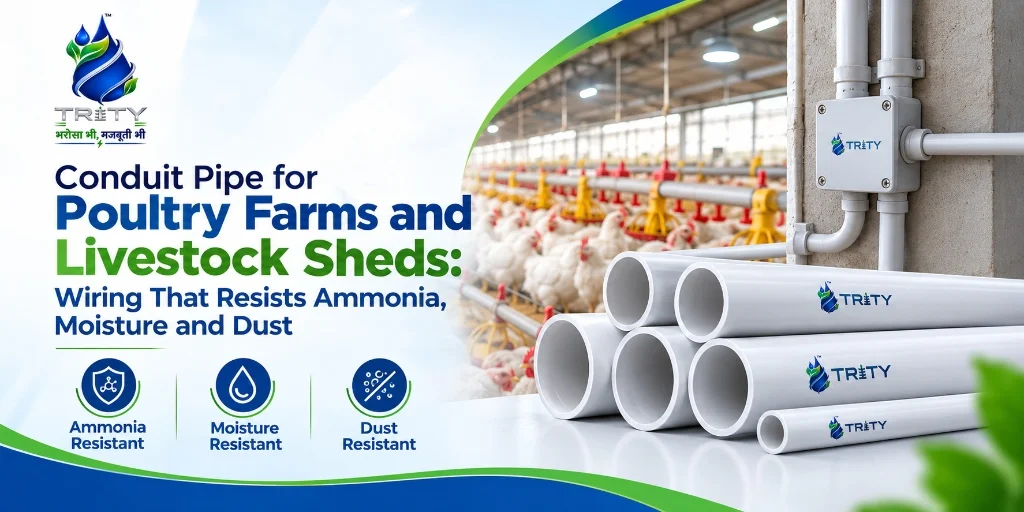
A poultry house is one of the hardest environments for electrical wiring. Birds produce ammonia, the air is humid, dust from feed and bedding settles on everything, rodents chew cables, and the shed is regularly washed down. Add fans, feeders, lighting and heaters running for long hours, and you have an electrical system under constant stress. Many farms find that wiring that looked fine in the first year starts to fail in the second or third.
Conduit pipe is a simple, low-cost way to protect that wiring. This guide explains why poultry and livestock sheds are so hard on electrical systems, why uPVC conduit suits them, how to install and seal it correctly, and how to choose grade and fittings. It is written for farm owners, poultry integrators, electricians and agri-infrastructure contractors.
Why poultry houses destroy ordinary wiring
Five conditions combine to damage electrical systems in livestock buildings.
- Ammonia and other corrosive gases. They attack metal, corrode terminals and can degrade unprotected cable sheaths and enclosures over time.
- Moisture. Humidity, misting and foggers, and regular washing keep surfaces damp, which causes short circuits and corrosion.
- Dust. Feed and bedding dust builds up in boxes and panels and can cause overheating and fire.
- Rodents and animal contact. Unprotected cable is a target for rats, and animals can damage low-level wiring.
- Long operating hours. Ventilation fans, lighting and feeding systems run for most of the day, so circuits carry load continuously.
Studies and extension guidance on farm safety consistently point to electrical failure as a leading cause of farm fires. In a shed full of birds, a single fault during hot weather can mean a ventilation failure or a fire, either of which is costly.
Why uPVC conduit suits poultry and livestock sheds
Compared with metal conduit and unprotected cable, uPVC conduit has several advantages in these buildings.
- It does not rust or corrode. Metal conduit and boxes are attacked by ammonia and moisture, while uPVC is not affected in the same way.
- It encloses the cable. A cable inside a conduit is much harder for rodents to reach and is shielded from moisture, dust and contact.
- It is non-conductive. There is no risk of the conduit itself becoming live if insulation is damaged.
- It is smooth and easy to clean. Surface conduit can be washed down along with the rest of the shed.
- It is economical. Compared with specialised armoured systems, uPVC conduit is light on cost and easy to install and extend.
It is still important to choose a good quality compound and proper fittings, and to confirm with the manufacturer that the product suits the cleaning chemicals and disinfectants used on your farm. Our guide on the best pipe for electrical wiring protection compares conduit materials in more detail.
Surface mounting versus concealed wiring in sheds
Poultry and livestock sheds are typically open, lightly built structures, and farm electrical guidance generally favours surface-mounted wiring in such buildings.
- Surface mounting is easier and cheaper to install and to inspect
- It does not interfere with vapour barriers or insulation in controlled-environment houses
- Faults can be seen and repaired quickly
- It suits the way sheds are extended and reconfigured over time
Use rigid uPVC conduit fixed securely with saddles at proper spacing, and keep runs tidy so that dust and debris do not collect behind them. Our guide on concealed and surface wiring explains the differences, and for farm sheds, surface wiring is usually the practical choice.
Choosing the right grade
- HMS (Heavy Mechanical Stress) is the best choice for low-level runs, wash-down areas, near feeders and anywhere there is physical contact from equipment, trolleys or workers.
- MMS (Medium Mechanical Stress) is suitable for higher, protected runs along walls and roof structure.
- LMS is generally not recommended in livestock buildings because of the knocks and cleaning the wiring faces.
Our LMS, MMS and HMS guide explains how to choose, and our conduit pipe size chart helps match size to cable fill for fan, lighting and feeder circuits.
Fittings, boxes and sealing
Good conduit can still fail if the fittings let moisture and dust in.
- Use moisture-proof, dust-tight boxes with gaskets on all covers. In wash-down areas, aim for a high ingress protection rating, with IP55 commonly used where hosing is done and IP65 where dust is heavy.
- Enter boxes from the side or bottom wherever possible so water cannot run down the conduit into the box.
- Use proper glands and connectors at every conduit-to-box connection so the joint is sealed.
- Seal the conduit to prevent condensation from travelling along the pipe.
- Keep panel boxes clean and closed. Dust inside a panel can cause overheating and fire, so check and clean panels regularly.
- Choose solvent-welded joints made correctly. Follow the cure time before the shed is washed or humid.
Our guide on uPVC conduit fittings explains which fittings to use at bends, joints and boxes.
Circuit planning for a poultry house
A well-planned electrical layout is easier to protect and to maintain.
Separate the critical circuits
Ventilation fans, feeders, drinker lines, lighting and heaters should be on separate circuits, so a fault in one does not shut down everything. Fans are the most critical in hot weather, so they deserve dedicated, well-protected circuits.
Plan for growth
Farms expand, and equipment is upgraded. Leave spare capacity in the conduit and in the distribution board for additional fans, automated feeders or lighting changes.
Earthing and residual current protection
Proper earthing, tested regularly, and residual current protection on final circuits are essential in a wet, animal-occupied environment. Animals and workers are both sensitive to electric shock, and moisture raises the risk. Have a qualified electrician inspect the installation at least once a year.
Outdoor and semi-open sections
Open-sided sheds and outdoor runs between buildings see sunlight. Use UV stabilised conduit for exposed runs. Our guide on UV resistant conduit for outdoor wiring explains what to confirm with the manufacturer.
Expansion allowance on long runs
Poultry sheds are often long, and uPVC expands and contracts with temperature. A long, rigidly fixed run can put stress on joints. Use expansion couplers at suitable intervals and avoid fixing every bracket tightly along the full length. This small detail prevents cracked joints in hot weather.
Common mistakes on farm wiring
- Using standard indoor boxes and covers that let moisture and dust in
- Running unprotected cable across rafters where rodents can reach it
- Putting fans, lights and feeders on one circuit
- Entering boxes from the top, where water collects
- Skipping earthing checks after cleaning and repairs
- Never cleaning panels, so dust builds up
- Choosing the cheapest, thin-walled conduit that cracks within a couple of seasons
Our guide on common conduit pipe installation mistakes lists more installation errors worth avoiding.
Why farms and contractors choose Trity Pipes
Trity Pipes is a manufacturer of uPVC conduit pipes and fittings made from lead-free, high-grade virgin raw materials, certified to IS 9537 Part 3 with ISO certification. For poultry, dairy and livestock projects, that gives you:
- HMS, MMS and LMS grades so you can match strength to each part of the shed
- A complete set of fittings from one manufacturer, including bends, couplers, boxes and saddles
- Consistent quality from controlled extrusion and in-process checks, which means fewer cracked pipes and fewer replacements
- Project and bulk quotations for integrators and contractors setting up multiple sheds
- A plant in Delhi NCR and a network of more than 250 distributors and 1,500 dealers across 20-plus states for supply close to your farm
View the uPVC conduit pipes and fittings range, verify our credentials on the certifications page, and ask our team for the Trity Pipes price list for your requirement.
A simple maintenance routine for farm wiring
Even well-installed conduit benefits from regular checks, especially in a harsh environment.
- Monthly: look over visible conduit, boxes and covers for damage, loose fixings or gaps, and clean dust from panel boxes
- After every flock or wash-down: check seals and covers, confirm nothing has been knocked loose, and make sure boxes are dry before power is restored
- Every year: have a qualified electrician test earthing, residual current devices and insulation, and inspect all terminations
- After any repair: reseal the conduit entry and confirm the cover gasket is seated properly
A short written log of these checks helps you spot repeating problems and gives insurers and inspectors a clear record.
Dairy farms, piggeries and other livestock buildings
The same principles apply across livestock buildings. Dairy sheds have milking equipment, cooling tanks and wash-down areas. Piggeries and cattle sheds have heavy moisture and corrosive gases. In each case, rigid uPVC conduit with sealed, gasketed boxes, HMS grade at low level, proper earthing and regular inspection is a sound approach. Hatcheries and feed mills add dust and high moisture, so apply the same sealing and cleaning discipline. If your project has unusual conditions, such as strong disinfectants or very high temperatures, share the details with our technical team so we can confirm the right specification.
How to order conduit from Trity Pipes for a farm project
Farm owners, poultry integrators and contractors can contact us with the number of sheds, the layout and the circuits planned. Our team will recommend grade and sizes, prepare a quotation for the full set of pipe and fittings, and plan delivery in phases if the farm is being built in stages. If you set up many farms, we can discuss a repeat supply arrangement so every site gets the same specification. Dealers who serve farm customers can also explore a partnership with us, and our guide on how to sell conduit pipe as a dealer shows how to win agricultural customers.
Frequently Asked Questions
Is uPVC conduit suitable for poultry farm wiring?
Yes. uPVC conduit does not rust or corrode like metal, it encloses the cable against moisture, dust and rodents, and it is easy to install and clean. Choose a good quality compound, proper grade and sealed fittings, and confirm compatibility with your cleaning chemicals.
Which conduit grade should I use in a poultry shed?
HMS grade is best for low-level and wash-down areas and wherever there is physical contact. MMS suits higher, protected runs. LMS is generally not recommended in livestock buildings.
Should poultry shed wiring be surface mounted or concealed?
Surface mounting is generally preferred in sheds. It is cheaper, easier to inspect and repair, and does not interfere with vapour barriers or insulation.
What IP rating should boxes and fittings have in a poultry house?
IP55 is commonly used where areas are hosed down, and IP65 where dust is heavy. Choose gasketed, moisture-proof boxes and seal every conduit entry.
How can I protect farm wiring from rats?
Run cable inside rigid conduit, keep runs off the floor where possible, seal all openings and avoid leaving loose cable across rafters. A closed conduit system is far harder for rodents to damage than exposed cable.
Does Trity Pipes supply conduit for large farm projects?
Yes. Share your shed count, layout and quantity needs, and our team will prepare a bulk or phased quotation and discuss grade and fittings for your farm.
Setting up wiring for a poultry, dairy or livestock operation? Contact Trity Pipes to get a project quotation, the Trity Pipes price list and technical advice from an ISO-certified uPVC conduit pipe manufacturer.