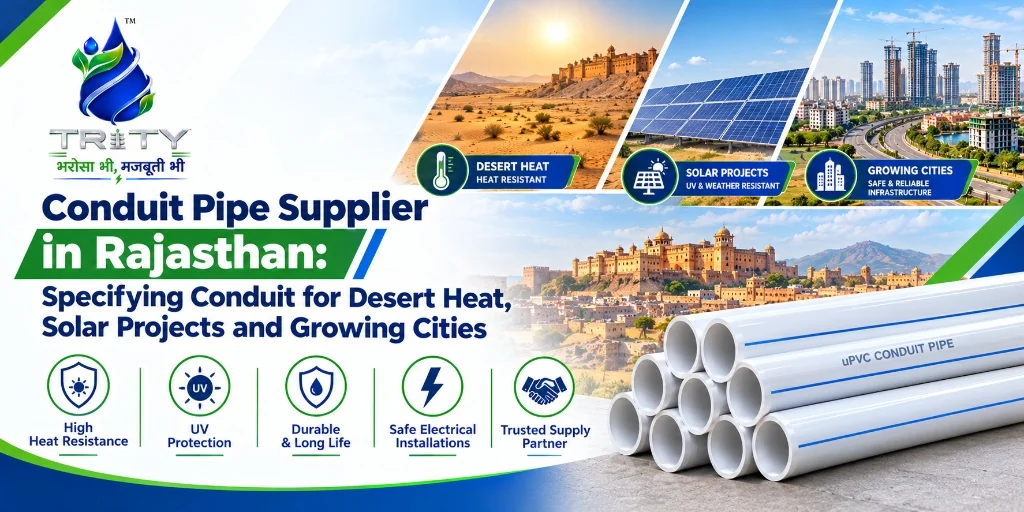
Rajasthan is a market with two faces. On one side are fast-growing cities like Jaipur, Jodhpur, Udaipur and Kota, with new housing, hospitals, colleges and commercial buildings. On the other is the state's role as India's leading solar region, with large solar parks and a growing rooftop solar market. Both need conduit pipe, and both put it through some of the harshest conditions in the country: intense sun, high summer temperatures, dust and wide daily temperature swings.
This guide is for contractors, solar installers, builders and dealers in Rajasthan. It explains how the climate changes conduit specification, what each major project type needs, how supply works from our factory in Delhi NCR, and how to get a Trity Pipes quotation or start a dealership.
Why Rajasthan is a strong conduit market
- India's leading solar state. Rajasthan has more installed solar capacity than any other state, including large utility-scale parks such as the Bhadla Solar Park near Jodhpur, which is among the largest in the world. Solar projects need conduit for DC and AC cable routing across large sites and on rooftops.
- Growing cities. Jaipur, Jodhpur, Udaipur, Kota, Ajmer and Bikaner are all adding housing, commercial space, hospitals and institutions.
- Highway and industrial development. Expressway corridors such as the Delhi-Mumbai Expressway through eastern Rajasthan are bringing logistics parks, industrial areas and new townships.
- Tourism and hospitality. Hotels, resorts and heritage property upgrades involve large electrical works.
Each of these adds up to steady and repeated conduit demand.
What Rajasthan's climate does to conduit
Specification in Rajasthan needs more care than in a temperate region, because the same pipe faces tougher conditions.
Intense sunlight and UV
Rajasthan receives some of the highest solar radiation in India, with many clear days in a year. Unprotected PVC exposed to this sun can discolour, chalk and turn brittle over time. Any conduit that stays exposed, such as rooftop runs, outdoor wall wiring, solar array cabling and boundary lighting, should be UV stabilised. Our guide on UV resistant conduit for outdoor wiring explains what UV stabilisation means and what to confirm with a manufacturer.
High temperatures and thermal expansion
Summer surface temperatures on exposed conduit can be very high, and uPVC expands and softens with heat. In practice:
- Use closer saddle spacing on exposed horizontal runs to prevent sagging
- Add expansion couplers on long straight runs so thermal movement does not stress joints
- Avoid tightly fixing every bracket along the full length of a run
- Keep stored pipe in shade and flat, so it does not bow before installation
Dust and sandstorms
Fine dust gets into every opening. Use sealed boxes, proper glands and covers, and close open conduit ends during installation.
Wide day-night temperature swings
Desert regions can cool sharply at night. Repeated expansion and contraction is another reason to design for thermal movement.
Conduit for solar projects in Rajasthan
Solar is the single biggest reason conduit demand in Rajasthan differs from other states. Solar cabling runs outdoors for decades under full sun, so the conduit must last as long as the plant.
- Rooftop solar: conduit protects DC string cables and AC cabling along rooftops, down walls and into inverter and meter rooms. Use UV stabilised conduit with secure fixing and sealed boxes.
- Ground-mounted and utility-scale solar: conduit protects cabling between arrays and inverters, often with underground sections. Underground runs need adequate depth and mechanical protection.
- Inverter rooms and control buildings: these follow standard building wiring practice, with MMS or HMS grade depending on traffic and exposure.
Our detailed guide on conduit pipe for solar panel wiring covers cable routing, sizing and life-cycle considerations for solar installations.
Which grade for which Rajasthan project
| Project type | Typical use | Suggested grade |
|---|---|---|
| Houses and apartments | Concealed wiring | MMS |
| Hotels and resorts | Concealed, high-quality finish | MMS, HMS in service areas |
| Hospitals and schools | Concealed, certified material | MMS, HMS in exposed areas |
| Warehouses and industrial units | Exposed runs, traffic | HMS |
| Rooftop and ground solar | Outdoor, exposed to sun | HMS, UV stabilised |
| Underground cable runs | Buried protection | HMS |
Use this as a starting point, with your specification and consultant's requirements taking priority. Our LMS, MMS and HMS guide explains the differences, and our guide on underground conduit pipe for cable protection covers buried runs.
How supply works from Delhi NCR to Rajasthan
Our factory and head office is at Phase 3, I-45, MG Road, Industrial Area, Shekhpur Khichara, Amapur Lodha, Ghaziabad, Uttar Pradesh 201015, in Delhi NCR. Rajasthan is a large state, and the best supply route depends on where your project is.
- Eastern and northern Rajasthan (Alwar, Jaipur, Bhiwadi, Ajmer) is nearer to NCR and often works well with direct supply from the factory.
- Western and southern Rajasthan (Jodhpur, Bikaner, Udaipur, Kota) is further away, and for regular needs, supply through a local distributor or dealer is usually the more practical route.
- Large solar and infrastructure projects can be planned as phased deliveries from the factory, with quantities and dates agreed in advance.
Delivery time depends on quantity, location and current stock, and our team confirms it when issuing a quotation. A bulk or phased quotation helps you lock in the supply plan early. Our guide on buying conduit pipe in bulk explains how to structure the enquiry.
Installation tips for Rajasthan conditions
- Store pipe in shade, flat and supported, away from direct sun, until it is used.
- Use proper saddle spacing on exposed runs and add expansion couplers on long stretches.
- Allow joints to cure fully before the pipe is exposed to heat and sun.
- Seal boxes and conduit ends against dust.
- Use UV stabilised conduit wherever it will stay in the open.
- Avoid forcing bends in hot or cold conditions. Our guide on bending uPVC conduit without cracking covers technique.
- Avoid common site mistakes. Our guide on conduit pipe installation mistakes lists errors worth checking.
Why Rajasthan contractors and installers choose Trity Pipes
- IS 9537 Part 3 conduit made with ISO certification
- Lead-free, high-grade virgin raw materials and in-process quality control
- LMS, MMS and HMS grades with a full fittings range
- Project and phased quotations for solar, housing and industrial work
- Technical guidance on exposed and UV-sensitive applications. For outdoor and solar projects, ask our team to confirm the grade and specification suited to your site
- A network of more than 250 distributors and 1,500 dealers across 20-plus states
- A broader product line, including CPVC, SWR, pressure, column and casing pipes
Browse the uPVC conduit pipes and fittings range, see our credentials on the certifications page, and ask for the Trity Pipes price list for your requirement.
Dealership and distribution opportunities in Rajasthan
Rajasthan's cities and district towns are growing, and solar and construction activity reaches well beyond the major cities. A dealer with reliable stock, a full fittings range and genuine certification can win electricians, contractors and solar installers in their area.
If you run a hardware, electrical or building material business in Rajasthan, you can apply to become a Trity Pipes dealer or distributor. Our guide on becoming a Trity Pipes dealer covers eligibility and documents, and our sales playbook for conduit dealers shows how to win repeat orders from local electricians and installers.
How to order from Trity Pipes in Rajasthan
- Contact us on +91-9821030072 or +91-9319984755, by email at info@tritypipes.com, or through the contact form.
- Share your requirement: project type, sizes, grades, quantity, delivery town and whether runs are exposed to sun.
- Receive a quotation with rate, validity and delivery basis.
- Request certification documents for approvals, if needed.
- Agree delivery phases that match your site programme.
A practical specification checklist for rooftop solar
Installers and EPC teams working on rooftops in Rajasthan can use this list when finalising the conduit scope.
- Confirm that every exposed section uses UV stabilised conduit
- Choose HMS grade where cable runs are exposed to foot traffic or maintenance work
- Plan saddle spacing for the heat, and add expansion couplers on long straight runs
- Use sealed, dust-tight boxes at every change of direction and at the inverter
- Keep DC and AC runs clearly separated and labelled
- Allow for cable growth and future array expansion in conduit sizing
- Seal conduit entries into buildings against water and dust
- Keep batch records and certificates for the commissioning file
Hotels, resorts and heritage buildings
Rajasthan's hospitality sector has particular needs. Heritage property upgrades often require surface-mounted conduit that causes minimum damage to old walls, and in new resort construction, concealed wiring keeps a clean finish for guests. Large hospitality projects also involve outdoor lighting, courtyards and landscape circuits that need UV stabilised, sealed conduit. Our guide on concealed and surface wiring explains how to choose between the two for each part of a building.
Common issues seen in desert installations
- Pipe stored in direct sun before use, which can deform or weaken it
- Rigidly fixed long runs that crack at joints after a few summers
- Open conduit ends that let dust and insects enter
- Non-UV-stabilised conduit used on exposed rooftops, which discolours and turns brittle
- Boxes without proper seals, which collect dust and moisture
- Solvent joints exposed to heat before they cure
Most of these are easy to avoid with the right material and a few site practices. If you are unsure about a specific condition, send us details of your application and our technical team will advise before you order.
Frequently Asked Questions
Does Trity Pipes supply conduit pipe in Rajasthan?
Yes, we supply Rajasthan through direct project orders from our Delhi NCR factory and through our dealer and distributor network. Delivery time depends on quantity, location and stock, and our team confirms it with your quotation.
Which conduit is best for rooftop solar wiring in Rajasthan?
Exposed solar cable runs need conduit that is UV stabilised and fixed securely, usually in HMS grade. Share your project details with our technical team and we will confirm the right grade and specification.
Does extreme heat damage uPVC conduit?
Heat makes uPVC expand and, on exposed runs, soften slightly. With proper saddle spacing, expansion couplers on long runs and UV stabilised compound for exposed sections, uPVC conduit performs well. Avoid leaving pipe in direct sun before installation.
What grade of conduit should I use for houses in Jaipur or Jodhpur?
MMS grade is the usual choice for concealed wiring in houses and apartments, and HMS suits slabs, exposed runs and areas with greater mechanical risk. Confirm against your electrician's or consultant's specification.
How can I become a Trity Pipes dealer in Rajasthan?
Fill in the Become a Distributor form on our website or contact our team. We will discuss your town, your current business and the range you want to stock.
Can I get a bulk quotation for a large solar or construction project in Rajasthan?
Yes. Share your sizes, grades, quantities and delivery schedule, and our team will prepare a quotation with the rate validity and phased delivery plan stated clearly.
Looking for a conduit pipe supplier in Rajasthan? Contact Trity Pipes on +91-9821030072 for a project quotation, the Trity Pipes price list and ISO-certified uPVC conduit pipe supplied from Delhi NCR.