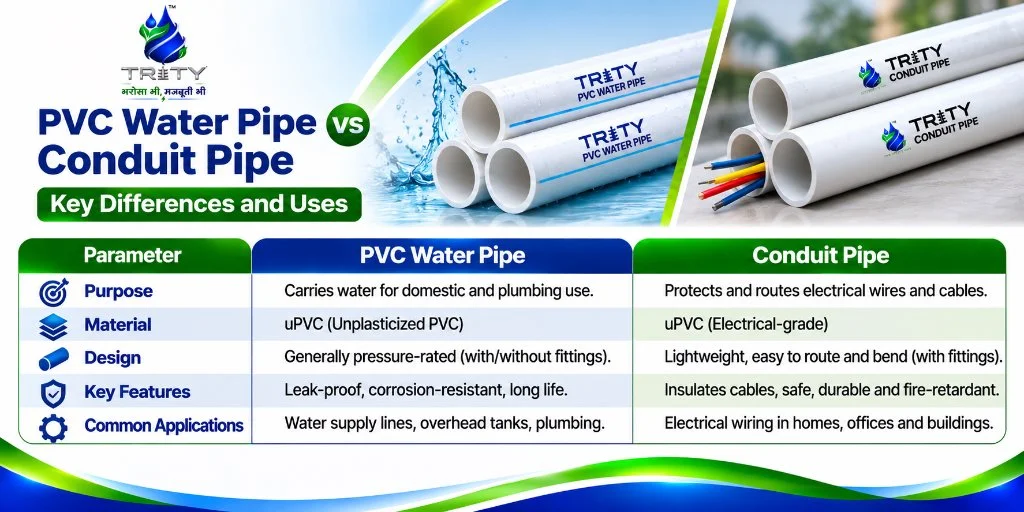
A common site conversation goes like this. The electrician needs pipe to protect the wiring, the shop has PVC water pipe in the right diameter at a similar price, and someone says, "pipe toh pipe hai, chalega." Sometimes it goes the other way: leftover conduit gets used for a small water or drainage line. In both cases, the pipe fits and nothing happens on day one.
The risks show up later. Pipes are made to different standards for different jobs, and a pipe that is perfect for water can be wrong for wiring, and the other way around. This guide explains how PVC water pipe and conduit pipe differ, why using one for the other is risky, how to tell them apart on site, and what to buy for each job.
What each pipe is made for
Conduit pipe
Electrical conduit protects insulated cables. It is a non-pressure pipe made to IS 9537 (Part 3 for rigid PVC conduit), and the standard tests the features that matter for wiring: dimensions that match fittings and boxes, impact and compression strength, resistance to heat, resistance to burning and flame behaviour, and electrical properties. It comes in three strength grades, LMS, MMS and HMS, chosen by mechanical risk. Its job is to keep cable safe, to slow the spread of fire along wiring and to let cable be pulled and replaced.
PVC water pipe
PVC pressure pipe for cold water supply, irrigation and borewells is made to IS 4985 and classified by pressure, from Class 1 to Class 6. It is tested to hold water pressure, including hydrostatic testing at a multiple of its working pressure and reversion testing. Its job is to carry pressurised water safely, and its material is chosen for that.
SWR drainage pipe
SWR pipe is made to IS 13592 for non-pressure drainage of soil, waste and rainwater, with sockets or ring joints, and wall thickness set for drainage.
Side by side
| Feature | Conduit pipe | PVC pressure pipe | SWR pipe |
|---|---|---|---|
| Purpose | Protect electrical cable | Carry pressurised water | Carry drainage by gravity |
| Indian standard | IS 9537 (Part 3) | IS 4985 | IS 13592 |
| Rated by | Strength grade: LMS, MMS, HMS | Pressure class, Class 1 to 6 | Type A or Type B |
| Tested for | Impact, compression, heat, burning, flame behaviour, electrical properties | Hydrostatic pressure, reversion | Dimensions, impact, drainage service |
| Fire behaviour tested | Yes, as part of the standard | Not a design requirement for the job | Not a design requirement for wiring use |
| Fittings | Conduit couplers, bends, junction boxes, saddles | Pressure fittings and solvent cement | SWR bends, junctions, traps |
| Sizes | Typically 16mm to 63mm and above | Typically 20mm to 315mm and above | 40mm to 315mm |
Each pipe is shaped for its own job, which is why the right choice is the pipe made for the purpose.
Can you use PVC water pipe as electrical conduit?
The short answer is that it is not recommended and often not allowed. The reasons are practical.
- It is not tested for the things that matter in wiring. Conduit standards include flame and heat behaviour for wiring installations. Water pipe standards do not set the same flame behaviour requirements, so you do not know how the pipe behaves in a fire.
- Dimensions do not match the electrical ecosystem. Conduit fittings, junction boxes and saddles are made for conduit dimensions. A water pipe of the same nominal size can have different outside and inside diameters, which causes loose fits and poor joints.
- Wall and bore may be wrong. A thick-walled pressure pipe reduces the usable bore for cable pulling, while a thin-walled pipe may not give the impact protection a given conduit grade does.
- It may fail inspection. Electrical inspectors, consultants and insurers expect conduit that is marked to IS 9537. Water pipe in a conduit role can be rejected, and then it has to be replaced.
- Appearance and labelling confuse later work. A water pipe in a wall can mislead a future plumber or electrician about what it is.
- There is no real saving. Conduit costs little, and the cost of rework or a safety problem is far higher.
For installation inside concealed walls, where you cannot see or change the pipe later, using the right pipe from the start matters most.
Can you use conduit pipe for water or drainage?
No. Conduit is not made or tested to hold water pressure, and its joints and fittings are not designed to seal against water. A conduit used for a water line can burst, leak or fail at joints. For drainage, conduit is not designed for the wall thickness, joint seals or fittings that drainage needs. Use pressure pipe for water supply, CPVC for hot water and SWR for drainage.
How to tell the pipes apart on site
You can usually tell by the marking, the colour, the wall and the fittings.
- Marking. Conduit carries IS 9537 and the grade (LMS, MMS or HMS) on the pipe, pressure pipe carries IS 4985 and the class, and SWR carries IS 13592 and the type. If there is no marking, treat the pipe with suspicion
- Wall thickness. Pressure pipe and SWR pipe walls are generally heavier than light conduit of the same diameter. Measure with a caliper and compare with the datasheet
- Colour. Colour varies between manufacturers and is not a reliable guide. Our guide on conduit pipe colour options explains why
- Fittings. Conduit systems use conduit couplers and junction boxes, and plumbing systems use pressure or SWR fittings
- Supplier. Buy conduit from the conduit range of a manufacturer, with documents that show the standard
Why electricians still sometimes use water pipe
There are a few reasons, and none of them is good.
- Price. Some water pipe is cheaper than certified conduit of the same nominal diameter, usually because it is thinner or not certified
- Availability. The shop had it in stock
- Habit. "We have always done it"
- Not knowing the standards
A very low price for a pipe sold as conduit is often a sign that it is not made to IS 9537. Our guide on how to identify fake or substandard conduit pipe explains the checks, including verifying the BIS licence and measuring wall thickness.
What to buy for each job
| Job | Right pipe |
|---|---|
| Protecting wiring in walls and slabs | Conduit to IS 9537, in the grade for the application |
| Exposed wiring and outdoor runs | HMS conduit, with UV-stabilised compound where exposed |
| Hot and cold water in a home | CPVC to IS 15778 |
| Cold water mains, irrigation, tank lines | uPVC pressure pipe to IS 4985 |
| Toilet, bathroom and kitchen drainage | SWR pipe to IS 13592 |
| Borewell | Column and casing pipes made for borewells |
Choose by job, not by diameter.
Choosing the right conduit grade
If you are buying conduit, pick the grade for the application. LMS suits light, protected indoor runs, MMS suits most concealed wiring and HMS suits exposed runs and heavier mechanical risk. Our LMS, MMS and HMS guide explains how to choose, and our conduit pipe size chart shows which size suits which circuit. For the standard itself, read our guide on IS 9537 Part 3.
What about flexible conduit and other options
Flexible conduit, rigid metal conduit and other systems exist for special cases, such as short connections to machines or places where metal protection is specified. They serve different needs and follow their own standards. For general wiring in buildings, rigid uPVC conduit to IS 9537 is the most common choice, and it is the one most project specifications call for. Our guide on the best pipe for electrical wiring protection compares the options.
Conduit from Trity Pipes
Trity Pipes manufactures uPVC electrical conduit pipes and fittings to IS 9537 Part 3 in LMS, MMS and HMS grades, from lead-free, high-grade virgin raw materials, with ISO 9001:2015 certification. We make matching fittings so that pipe, couplers, bends and boxes fit together, and we make CPVC, uPVC pressure and SWR pipes for the water and drainage side, so each job can use the right pipe from one manufacturer. Our team can share certification documents and help you choose grade and size. See the uPVC conduit pipes and fittings range, and our certifications page. Electricians, contractors and dealers can ask for the Trity Pipes price list.
Frequently Asked Questions
Can I use PVC water pipe for electrical wiring?
It is not recommended and often not allowed. Water pipe is not made or tested to IS 9537 for flame behaviour, heat resistance and conduit dimensions, and it may fail inspection. Use conduit marked to IS 9537.
Is conduit pipe the same as plumbing pipe?
No. Conduit protects cable and follows IS 9537, while plumbing pipes carry water and follow standards such as IS 4985 for pressure pipe, IS 15778 for CPVC and IS 13592 for SWR drainage.
Can I use conduit pipe for water?
No. Conduit is not rated to hold water pressure, and its joints are not designed to seal against it. Use pressure pipe for cold water and CPVC for hot water.
How do I know if a pipe is conduit?
Check the marking for IS 9537 and a grade such as LMS, MMS or HMS, and verify the BIS licence number. A pipe with no marking or an unverifiable ISI mark should be treated with caution.
Is SWR pipe suitable as conduit?
No. SWR pipe is designed for drainage and follows IS 13592, not the wiring-related requirements of IS 9537. Use conduit for wiring.
Where can I buy certified conduit pipe?
From a manufacturer or dealer who can show the BIS licence and test documents. Trity Pipes supplies IS 9537 Part 3 conduit, and our team can share certification documents and a quotation.
Choosing pipe for wiring? Contact Trity Pipes on +91-9821030072 or +91-9319984755 for certified conduit pipe, grade guidance and a quotation from our Delhi NCR factory.