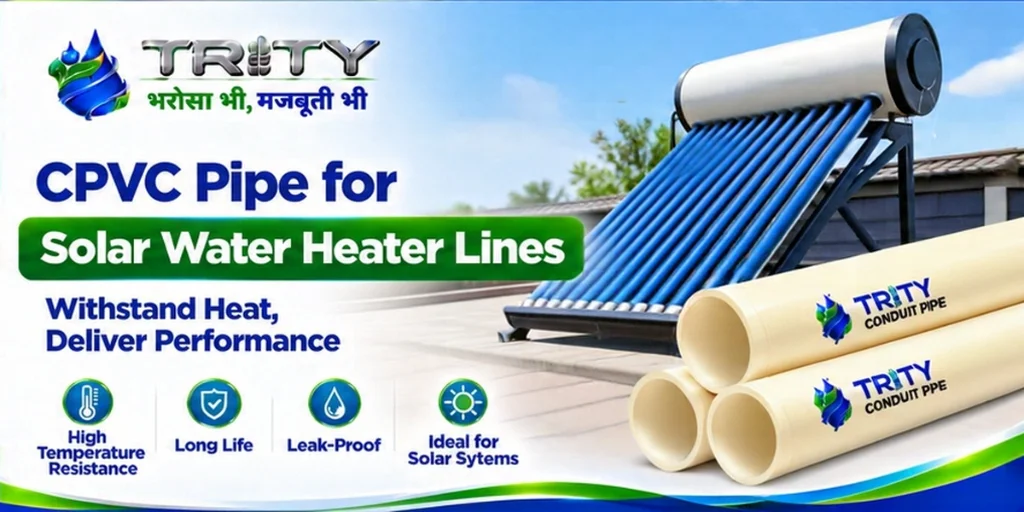
Solar water heaters are common on Indian rooftops, from small flat-plate and evacuated-tube systems on homes to large collector fields on hotels, hostels and hospitals. They save electricity every day, and they put the plumbing under stress that an ordinary electric geyser does not. On a hot, bright afternoon with no one drawing water, the water in a collector can heat well beyond the temperature a geyser thermostat would allow, and the pipe connected to it has to survive that day after day for years.
CPVC is widely used for hot water lines, but a solar installation needs a more careful specification than a standard geyser connection. This guide explains why solar loops are different, what to confirm with the solar supplier before choosing pipe, which class and fittings to use, how to insulate and support the pipe, how to allow for expansion and sun, how to test the system and how Trity Pipes supports installers. For the general design of hot and cold lines, read our guides on CPVC system design and CPVC pipe for bathroom and kitchen.
Why a solar water heater is harder on pipe than a geyser
An electric geyser heats water to a set temperature and then stops. The pipe sees a steady, controlled temperature. A solar water heater is different.
- Temperature depends on the sun. On a clear day with little or no hot water use, the water in the collector keeps heating.
- Stagnation. When there is no flow, for example when the tank is full and nobody is drawing water, the collector can reach temperatures well above normal use. This is called stagnation, and it is the worst-case condition for the pipe next to the collector.
- Daily thermal cycling. The pipe heats in the day and cools at night, every day, which tests joints and supports.
- Outdoor exposure. Pipe on the roof sees direct sun, rain and wind.
- Pressure and backflow. Some systems are open-vented from a tank, and others are pressurised, which changes the pressure the pipe sees.
The pipe closest to the collector therefore has the toughest duty. Pipe lower down the system, after the storage tank and mixing, usually sees more moderate conditions.
Check the temperature limits first
Before you choose any pipe, ask the solar water heater supplier for the maximum temperature and pressure the system can produce, including stagnation. That is the number to design to, not the normal operating temperature.
Under IS 15778, CPVC pipes are pressure tested at room temperature and at 82\u00b0C, and our product page rates Trity CPVC to about 93\u00b0C. If the collector loop can exceed the rating of the pipe under stagnation, CPVC should not be used on that section, and the supplier's recommended pipe or a metal section close to the collector should be used instead. Many solar systems use metal pipe for the section next to the collector, and CPVC for the cooler runs from the tank to the bathrooms. Follow the solar supplier's instructions, since they know the system's limits.
Where CPVC fits in a solar installation
- From the storage tank to the bathrooms and kitchen: the most common use, because water temperature is controlled by the tank and any mixing
- The cold water feed to the tank: CPVC or uPVC, depending on the design
- Recirculation lines in larger systems, where the water is within the pipe's rating
- The collector loop: only if the supplier confirms that CPVC is suitable for the highest temperature and pressure of the loop, which is often not the case for direct collector connections
When in doubt on any section, ask the solar supplier in writing.
Choosing the class
Trity's CPVC pipes and fittings are made to IS 15778 in 15mm to 50mm sizes in the CTS system, in SDR 11 and SDR 13.5 classes. For solar and geyser lines:
- SDR 11 is the sensible choice for the sections nearest the heat source, because it has a thicker wall and a higher pressure rating
- SDR 13.5 is often suitable for branches to bathrooms and kitchens, where temperature and pressure are lower
Your plumber or consultant should confirm the class for each part of the system from the pressure and temperature data. Our guide on CPVC pipe price explains how class affects cost.
Sizing
Size the hot line for the flow your fixtures need, and keep runs from the tank to the bathrooms short, because long hot lines waste water while you wait for it to arrive. For a typical home, 20mm is common for bathroom feed lines, 15mm for final connections and 25mm for a main feeding several fixtures. Our CPVC fittings guide shows how to count fittings from a plan.
Insulation matters more with solar
Insulating hot water pipes saves heat, and with solar it does more.
- Insulate every hot line, and especially long runs from the roof tank to the bathrooms, to hold the temperature the sun worked to produce
- Use insulation suitable for the pipe and temperature, and protect outdoor insulation from sun and rain with a cover or cladding, since exposed foam degrades
- Insulate fittings and unions as well as straight pipe, or heat leaks at every joint
- Keep pipe and insulation clear of the collector surface and any hot parts, as the supplier advises
Good insulation shortens the wait for hot water and increases the usable output of the system.
Expansion and support
CPVC expands noticeably when hot, and a long run on a roof sees large daily swings.
- Use offsets, loops or bends to absorb movement, instead of long, rigid, straight runs
- Support the pipe at suitable spacing, closer on hot lines
- Use clips that allow movement and do not crush or abrade the pipe
- Do not fix the pipe rigidly at both ends of a long straight section
- Allow movement where the pipe enters the tank or collector connection
Sun and weather on the roof
Exposed pipe on a roof faces UV and heat. Where CPVC is used outdoors, protect it with insulation and cladding, or use sleeves or covers, and ask the supplier about outdoor suitability. A short exposed section should be minimised, and long runs belong inside the building where possible. Our product page describes the sun-resistant behaviour of our pipes, and our team can discuss outdoor use for your site.
Fittings, unions and valves
A solar line needs the usual CPVC fittings: elbows, tees, couplers, reducers, unions and end caps, which Trity makes to the same dimensional tolerance as its pipe. In addition, you will need threaded connections and valves for the tank, the collector connections and the isolation points. Ask our team which of these are available to match your pipe.
- Use unions at the tank and at equipment, so that you can service them without cutting pipe
- Fit isolation valves so that sections can be drained without emptying the whole system
- Install the safety devices the solar supplier specifies, such as pressure and temperature relief valves
Jointing and testing
CPVC needs CPVC-specific solvent cement. Clean and dry the surfaces, apply cement evenly, insert fully, hold and allow full cure time before pressure testing. Test the system at the pressure the specification requires, check every joint, and repeat the test after the system has been heated for the first time, since thermal movement can reveal a weak joint. Keep records.
Common mistakes in solar plumbing
- Using CPVC next to the collector without checking the stagnation temperature
- Mixing PVC cement with CPVC pipe
- Leaving long hot lines uninsulated
- Fixing pipe rigidly along a long straight run
- Leaving insulation exposed to sun and rain
- Skipping unions and isolation valves
- Forgetting to test after the first heating cycle
Why installers and plumbers choose Trity CPVC
Trity Pipes manufactures CPVC pipes and fittings from high-grade, lead-free CPVC compound, to IS 15778, in 15mm to 50mm CTS sizes and SDR 11 and SDR 13.5 classes, with ISO 9001:2015 certification. Our team can help solar installers and plumbers choose the class for each part of a system, share IS 15778 test reports and certification documents, and arrange sample batches for evaluation before a larger order. We dispatch from our Delhi NCR facility to 20-plus states, and installers who work on many systems can ask for bulk and standard-kit quotations. See the CPVC pipes and fittings range, and read our guide on how to check CPVC pipe quality before you buy. For bigger buildings, read our guide on CPVC pipe for commercial buildings and hotels. Dealers who serve solar installers and plumbers can ask about stocking the range, as described in our guide on the CPVC and plumbing range dealership.
Frequently Asked Questions
Can I use CPVC pipe with a solar water heater?
Yes, for many parts of the system, such as the hot lines from the storage tank to the bathrooms. For the section nearest the collector, confirm the maximum and stagnation temperatures with the solar supplier, and use the pipe they recommend.
What is stagnation in a solar water heater?
Stagnation is the condition when there is no flow through the collector, for example when no hot water is being used, and the water heats beyond its normal operating temperature. It is the worst-case temperature the nearby pipe must withstand.
Which CPVC class is best for solar and geyser lines?
SDR 11 is a sensible choice for sections nearest the heat source, and SDR 13.5 often suits branches to bathrooms and kitchens, as your plumber or consultant confirms from the pressure and temperature data.
Do I need to insulate CPVC hot water pipes on a solar system?
Yes. Insulating hot lines, fittings and unions keeps the heat the sun produced, shortens the wait for hot water, and outdoor insulation should be protected from sun and rain.
Can I mix PVC and CPVC cement or fittings?
No. CPVC needs CPVC-specific solvent cement, and fittings should match the pipe. Ordinary PVC cement is not suitable for hot water joints.
Can Trity Pipes supply CPVC in bulk for solar installers?
Yes. Share your sizes, classes and monthly volume, and our team will prepare a quotation and discuss delivery from our Delhi NCR factory. Sample batches and IS 15778 documents are available on request.
Planning a solar water heater or geyser line? Contact Trity Pipes on +91-9821030072 or +91-9319984755 for class guidance, IS 15778 documents and a CPVC pipes and fittings quotation from our Delhi NCR factory.