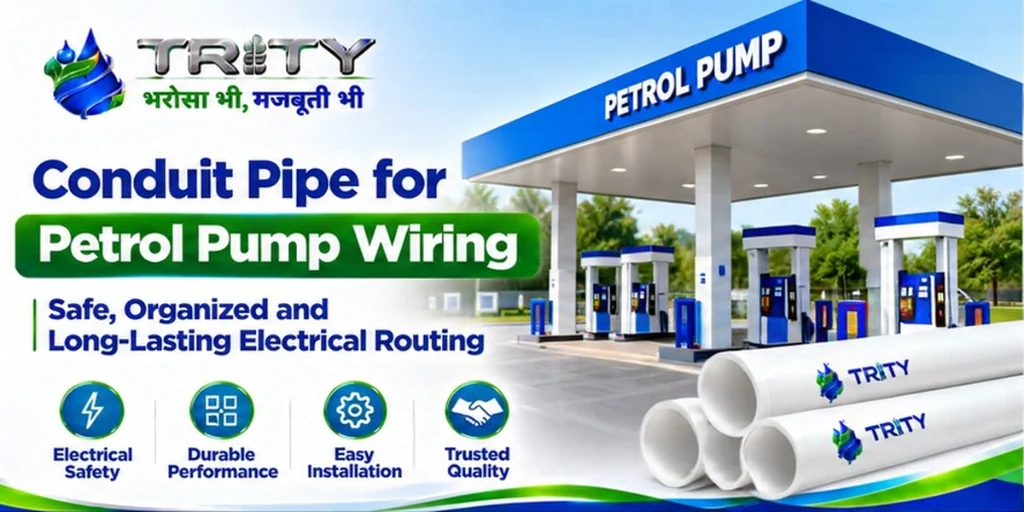
A petrol pump looks like a simple site: a canopy, some dispensers, an office and a shop. Electrically, it is one of the most regulated small sites there is. Fuel vapour near dispensers and tanks creates hazardous areas, where the wrong wiring method or the wrong equipment can start a fire. At the same time, the rest of the station, including the canopy lights, the convenience store, the office, the signage, the CCTV and the new EV chargers, is ordinary electrical work that needs good conduit.
This guide separates the two. It explains which parts of a fuel station suit uPVC conduit, which parts follow the oil company's specification and hazardous-area rules, how to plan underground runs on a forecourt, how fuel stations are adding EV charging, and how Trity Pipes supports contractors who build and refurbish stations. It is general information. At a fuel station, the oil marketing company's specification, your electrical consultant and the applicable safety rules decide what is permitted, and they take priority over anything written here.
Why a fuel station is different
- Hazardous areas. Flammable vapour can be present around dispensers, tank fill points, vents and some underground chambers. These zones are classified, and electrical equipment and wiring inside them must meet specific requirements.
- Regulated safety. Petroleum installations are governed by safety rules in India, enforced by authorities including the Petroleum and Explosives Safety Organisation, and oil companies add their own detailed specifications for their retail outlets.
- Standard layouts. Oil companies use approved designs, so contractors work to defined specifications.
- Heavy traffic. Tankers, cars and trucks cross the forecourt, so underground and surface wiring faces mechanical stress.
- Long operating hours. Many stations run around the clock, so lighting and dispensers need reliable circuits.
The key rule: classified zones follow the specification
Wiring inside classified hazardous areas, such as the immediate area around dispensers and tank openings, must follow the oil company's specification and the hazardous-area standards that your consultant applies. This usually involves certified equipment and specific wiring and sealing methods. Do not choose conduit for these zones on price or convenience. Ask the consultant or the oil company's engineer which wiring method is approved for each zone, and follow the drawing. If a drawing marks a zone as classified, it is outside the scope of ordinary conduit selection.
Where uPVC conduit fits at a fuel station
Outside the classified zones, a fuel station is full of ordinary circuits, and uPVC conduit is a good choice where the specification allows it.
The canopy
The canopy carries a large lighting load, with LED fixtures, signage and sometimes cameras. Conduit runs along the canopy structure and through columns. Exposed runs see sun, rain and heat, so use HMS grade with sealed boxes and UV-stabilised compound. Trity offers UV-stabilised variants for outdoor applications, and our team can confirm the grade and specification for your site. See our guide on UV resistant conduit for outdoor wiring.
The office and sales room
These are standard commercial wiring, with concealed conduit in walls and above ceilings. MMS grade suits concealed runs. Our guide on conduit pipe for commercial buildings covers the specification.
The convenience store and service areas
Convenience stores, restrooms, air and water points and car wash areas have lighting, refrigeration, point-of-sale and air conditioning circuits. Our guide on conduit pipe for retail store fit-outs applies here, and wet areas need sealed fittings.
Signage, pylons and boundary lighting
Price signs, pylons and boundary lights are outdoors and often fed by underground runs. Use HMS grade, UV-stabilised where exposed, with sealed boxes.
CCTV and networking
Fuel stations use many cameras and networked equipment. Plan separate low-voltage conduits, and read our guide on conduit pipe for smart home and CCTV wiring for routing, separation and pull boxes.
EV charging
Many fuel stations are adding EV charging bays, often in a separate area away from dispensers. Charging circuits are continuous heavy loads and need dedicated, properly sized routes. Our guide on conduit pipe for EV charging stations explains sizing and outdoor requirements. Follow the oil company's rules for where charging equipment can be placed relative to classified zones.
Rooftop and canopy solar
Some stations fit solar on the canopy or the shop roof. See our guide on conduit pipe for rooftop solar.
Underground runs on the forecourt
Most circuits on a forecourt run underground, from the main panel to the canopy, the pylons, the dispensers and the outbuildings.
- Follow the approved drawing for routes, depth and separation from fuel lines and tanks. Routes near fuel infrastructure are tightly controlled.
- Use HMS grade for buried conduit and for crossings under driveways where tankers pass, with additional protection as specified.
- Keep power and low-voltage data separate.
- Use pull chambers at changes of direction and at regular intervals, built to the specification.
- Seal conduit ends and entries into buildings and chambers, as the specification requires, so that vapour and water cannot travel through the conduit.
- Mark the route with warning tape, and keep accurate as-built drawings.
Our guide on underground conduit pipe for cable protection explains depth, bedding and protection in general terms. At a fuel station, the station's drawing and the oil company's specification take priority.
Choosing grade and size
| Area | Typical use | Suggested grade |
|---|---|---|
| Office, sales room | Concealed wiring | MMS |
| Convenience store | Concealed or surface | MMS, HMS where exposed |
| Canopy, pylon, boundary | Outdoor, exposed | HMS, UV stabilised |
| Underground forecourt runs | Buried, traffic crossings | HMS |
| CCTV and data | Separate conduits | MMS, HMS where exposed |
| EV charging bays | Outdoor, continuous load | HMS, UV stabilised |
This applies to non-classified areas only, and the oil company's specification takes priority. Our LMS, MMS and HMS guide explains the grades.
Fire safety and documentation
Fuel stations take fire safety very seriously.
- Use flame retardant conduit in non-classified areas. See our guide on fire resistant conduit pipe
- Follow the oil company's approved material lists and procedures. Many oil companies require approvals for materials used at their outlets, so submit documents early. Our guide on material approval submittals for conduit pipe explains what reviewers expect
- Keep installation records and test records, since the outlet will be inspected before commissioning
- Check the applicable code. Our guide on NBCS 2026 and conduit pipe explains the current fire and life safety framework and why local rules still decide
Planning supply for a new outlet or a refurbishment
- Confirm the approved materials list before you order
- Estimate quantities by area: canopy, store, office, forecourt and EV bays. Our guide on estimating conduit pipe for a BOQ explains the method
- Order matching material in a single batch where possible
- Phase delivery to follow construction, since fuel station projects are tightly scheduled
- Order fittings with the pipe
- For multi-site rollouts, use standard kits for each outlet type, and keep documents consistent
Why fuel station contractors choose Trity Pipes
Trity Pipes is a manufacturer of uPVC conduit pipes and fittings made from lead-free, high-grade virgin raw materials, certified to IS 9537 Part 3 with ISO certification. For fuel station projects, we offer:
- LMS, MMS and HMS grades with matching fittings
- Certification documents on our certifications page and on request for oil company or consultant approvals
- Technical guidance on where uPVC conduit fits in the non-classified parts of a station. We do not advise on classified zones, where the oil company's specification applies
- Project and rollout quotations with phased delivery and standard kits
- A Delhi NCR factory with dispatch to 20-plus states, so outlets across regions can be supplied
See the uPVC conduit pipes and fittings range and ask our team for the Trity Pipes price list.
Frequently Asked Questions
Can uPVC conduit be used at a petrol pump?
It can be used in the non-classified parts of a station, such as the office, shop, canopy, signage, CCTV and EV charging areas, where the specification allows it. In classified hazardous areas, follow the oil company's specification and your consultant's advice.
What is a hazardous area at a fuel station?
It is a zone, such as the area around dispensers and tank openings, where flammable vapour may be present. Wiring and equipment in these zones must meet specific requirements set by the applicable standards and the oil company.
Which conduit grade should I use on a fuel station forecourt?
HMS grade is the usual choice for buried runs and for exposed outdoor runs in non-classified areas, because of traffic and weather. Follow the approved drawing and the oil company's requirements.
Do oil companies approve conduit material?
Many oil marketing companies have approved materials lists and review submittals for their outlets. Check the requirements early and submit the conduit documents before ordering in volume.
Can fuel stations add EV charging?
Many are adding it, usually in separate bays. Charging circuits are continuous heavy loads and need properly sized routes, and the placement relative to classified zones must follow the oil company's rules.
Can Trity Pipes supply conduit for a multi-outlet fuel station rollout?
Yes, for the non-classified parts of stations. Share your specification, outlet count and locations, and our team will prepare a quotation with standard kits and phased delivery through our network across 20-plus states.
Building or refurbishing a fuel station? Contact Trity Pipes on +91-9821030072 or +91-9319984755 for a quotation, certification documents and phased supply of ISO-certified uPVC conduit pipe for the non-classified parts of your project.