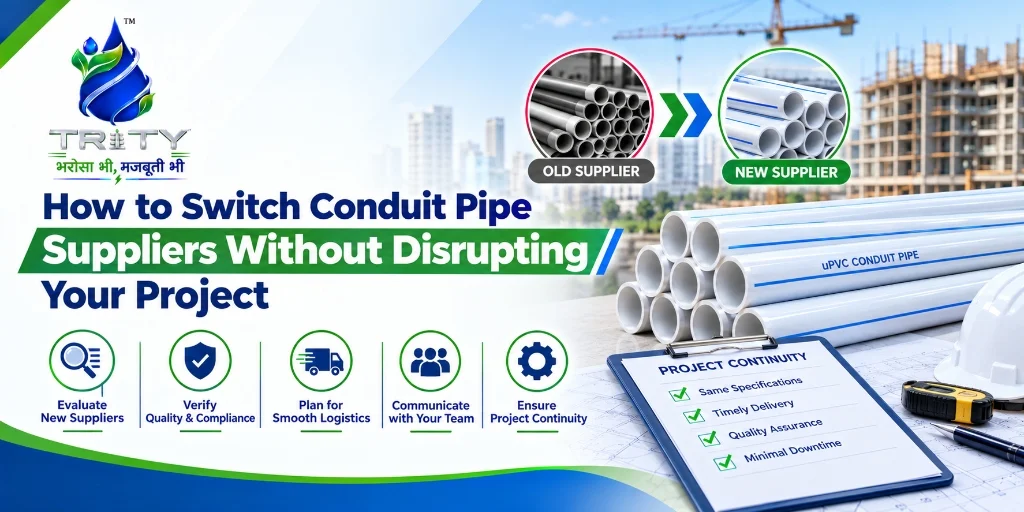
Most contractors and dealers who are unhappy with a conduit pipe supplier stay with them anyway. The reasons are practical. There is stock already on site, fittings that match the current pipe, a relationship that has lasted years, and a worry that a new supplier will cause more problems than the old one. Meanwhile, cracked pipes, late deliveries and missing paperwork keep costing money.
Switching suppliers does not have to be a leap. Done in stages, with a trial and clear checks, it is a controlled change that you can reverse if it does not work. This guide explains when switching makes sense, what the real risks are, a step-by-step plan, how dealers should handle a brand change, and how Trity Pipes supports a trial order.
Signs it is time to look at another supplier
Occasional problems happen with every supplier. Patterns are what matter.
- Inconsistent quality. Wall thickness, finish or dimensions vary between deliveries.
- Repeated cracking or failures during bending or installation that your team cannot explain by technique.
- Late or incomplete deliveries that delay site work more than once.
- Missing or unclear documentation, such as certificates you cannot verify or batch records that do not exist.
- Poor response to complaints, with slow replies and no resolution.
- Unstable pricing that changes between quotation and order without explanation.
- Weak technical support, so you are left guessing about grade or sizing.
Our guides on why uPVC conduit pipes break and how to identify fake or substandard conduit pipe help you work out whether the problem is the product or the installation before you decide.
The real risks of switching
It is worth naming the risks properly, because each has a practical answer.
Dimensional mismatch with existing material
Pipe and fittings from different manufacturers can differ slightly in outer diameter and socket size. Mixing them within one run can cause loose joints. The answer is to test fit before committing and to avoid mixing brands inside the same run.
Material approval on projects that need it
On projects with consultants, a new product usually needs a fresh approval. This takes time and has to be planned. Our guide on material approval submittals for conduit pipe explains what to prepare.
Unknown reliability
A new supplier has no track record with you yet. A trial order, references and a factory visit reduce this uncertainty.
Rate and terms differences
Payment terms, delivery basis and rate validity may differ. Compare on landed cost. Our guide on reading and comparing conduit pipe quotations shows how.
Relationship and credit with the old supplier
You may have credit, advances or goodwill with your current supplier. Plan the transition so that existing obligations are settled cleanly.
A step-by-step plan to switch with low risk
Step 1: Record what you currently use
List the sizes, grades, brands and fittings in use, along with the problems you have seen. Measure wall thickness and note the weight per metre of a sample. This becomes your baseline and your acceptance standard.
Step 2: Define what better looks like
Write down what you need from the new supplier: certification, consistency, delivery reliability, documentation, support and terms. Decide in advance how you will judge a trial.
Step 3: Shortlist and verify
Ask for the BIS licence number and check it, request ISO documentation, speak to a few existing customers and, where possible, visit the factory. Our guide on how to choose a conduit pipe manufacturer lists the questions to ask.
Step 4: Start with samples
Get samples in the sizes and grades you use, together with matching fittings. Check dimensions, wall thickness, weight, finish and marking against your baseline. Use the checks in our guide on identifying substandard conduit.
Step 5: Test fit
Join the new pipe with the new fittings and, if you must connect to existing runs, check how the new pipe fits with the old fittings. Do this on the bench before it happens on site.
Step 6: Place a pilot order
Order a meaningful but limited quantity, ideally for a non-critical phase or a single area, and treat it like a real order, with a written purchase order, agreed delivery date and full documentation.
Step 7: Refresh approvals if needed
If your project requires material approval, submit the new product early so that approval does not delay the cut-over.
Step 8: Cut over by phase, not all at once
Switch one floor, block or area at a time. Keep the old supplier's stock and contact available for a short overlap, so that a problem with the new supply does not stop work.
Step 9: Review the pilot against your criteria
After the pilot, compare quality, delivery, documentation, support and landed cost with what you wrote in Step 2. If it meets the standard, extend the order. If not, you have lost little and can revert.
Step 10: Document the change
Record batch details, locations installed and the date of the change in each area. This protects you if a question arises later and helps with warranty claims. Our guide on conduit pipe warranty and after-sales support explains what records to keep.
If you are a dealer changing brands
A dealer switching brands has extra considerations beyond the technical ones.
- Sell through existing stock of the old brand before you shift the shelf, rather than writing it off.
- Compare margins and terms on a like-for-like basis, including credit, volume tiers and freight.
- Check territory terms so you are not competing with another dealer of the same brand in your area.
- Tell your customers why you are changing and what they gain, such as better certification, consistent stock or better support. Our sales playbook for conduit dealers shows how to explain it at the counter.
- Keep both brands for a period if customers have projects specified with the old brand.
- Train your counter staff on the new range, sizes and fittings.
If you are considering becoming a Trity Pipes dealer, read our guide on how to become a Trity Pipes dealer and our comparison of dealer, sub-dealer and distributor models.
Mistakes to avoid when switching
- Changing everything at once instead of piloting
- Mixing pipe and fittings of different brands in the same run without testing fit
- Skipping the approval step on projects that need it
- Choosing on rate alone, without comparing grade, certification and terms
- Ignoring documentation until a problem appears
- Burning the old relationship before the new one has proved itself
- Not recording which batch went where
How Trity Pipes supports a trial order
Trity Pipes is a manufacturer of uPVC conduit pipes and fittings made from lead-free, high-grade virgin raw materials, certified to IS 9537 Part 3 with ISO certification. If you want to test us, our team can help you with:
- Samples of the sizes and grades you use, with matching fittings, so you can run your own checks
- Certification documents and technical datasheets for your approval process
- A pilot or trial quotation with the rate, validity, delivery basis and terms clearly stated
- Technical guidance on grade selection and fit with existing material
- A factory visit to see production, raw material storage and quality checks
- Phased delivery so that you can cut over one area at a time
You can see our credentials on the certifications page, browse the uPVC conduit pipes and fittings range and read about the company on our about us page. We have a network of more than 250 distributors and 1,500 dealers across 20-plus states, so supply support is available beyond our home region.
A simple scorecard for the trial
Judge the pilot against criteria you wrote before it started. A short scorecard keeps the decision objective.
| Criterion | What to check | Pass or fail |
|---|---|---|
| Dimensions and wall thickness | Measured against your baseline | |
| Finish and marking | Uniform surface, clear print line | |
| Fit with fittings | Joints seat properly without force | |
| Behaviour on site | Cuts, bends and joints without cracking | |
| Delivery | On the promised date, complete quantity | |
| Documentation | Certificates and batch records supplied | |
| Support | Questions answered quickly and accurately | |
| Landed cost | Compared on the same basis as the old supplier |
If most items pass and none of the failures is serious, extend the order. If any critical item fails, discuss it with the supplier and decide whether it can be corrected before you commit further.
How long a switch usually takes
The timeline depends on whether your project needs approvals and how much stock you already hold. For a contractor with no approval requirement, sampling, test fit and a pilot order can often be completed within a few weeks. Where consultant approval is needed, add the review time. Dealers changing brands should plan the transition around their existing stock and customer projects. A realistic plan avoids rushing and protects your site programme.
What to tell your site team
Switching is easier when the people on site know what is changing and why.
- Share the new product's marking, sizes and grades, so they can identify it
- Explain which areas will use the new supply and which will continue with the old
- Brief them on any difference in fittings or jointing
- Ask them to report any problem immediately, with photos and batch details
- Keep a simple log of installed locations and batches
A short briefing prevents most of the mix-ups that cause trouble during a changeover.
Why contractors and dealers try Trity Pipes
People who switch to Trity Pipes usually come to us for the same reasons: they want certification they can verify, consistent product from batch to batch, clear quotations and a manufacturer who answers the phone. Our conduit is made from lead-free, high-grade virgin raw materials with in-process quality control, and our team works with contractors and dealers on trial orders every year. If you want to see how we compare with your current supplier, ask for samples and a trial quotation, and run your own checks.
Frequently Asked Questions
Is it risky to change conduit pipe supplier in the middle of a project?
It carries some risk, but a staged plan reduces it. Pilot the new supplier on one area, test fit with fittings, keep the old supplier available for a short overlap, and refresh any required approvals before you cut over.
Can I mix conduit pipe and fittings from different manufacturers?
It is best to avoid mixing within the same run unless you have tested the fit. Dimensions can differ slightly between manufacturers, and loose joints cause problems later. Using matching pipe and fittings from one source is the safest approach.
Do I need new material approval if I change supplier?
On projects with a consultant or client approval process, a new manufacturer or product usually needs a fresh submittal. Submit early so it does not delay installation.
How big should a trial order be?
Large enough to be meaningful across the sizes and grades you use, and small enough that a problem does not stop the project. Many buyers choose a single floor, block or phase.
Can Trity Pipes supply samples before I place a trial order?
Contact our team with the sizes and grades you need, and we will discuss samples, documents and a trial quotation. You are also welcome to visit our Ghaziabad factory.
What should a dealer consider before changing brands?
Sell through existing stock, compare margins, credit and territory terms, tell customers why you are changing, and train counter staff on the new range. You can start by applying through the Become a Distributor form on our website.
Thinking about a change? Contact Trity Pipes on +91-9821030072 to request samples, certification documents and a trial quotation for ISO-certified uPVC conduit pipe from our Ghaziabad factory.